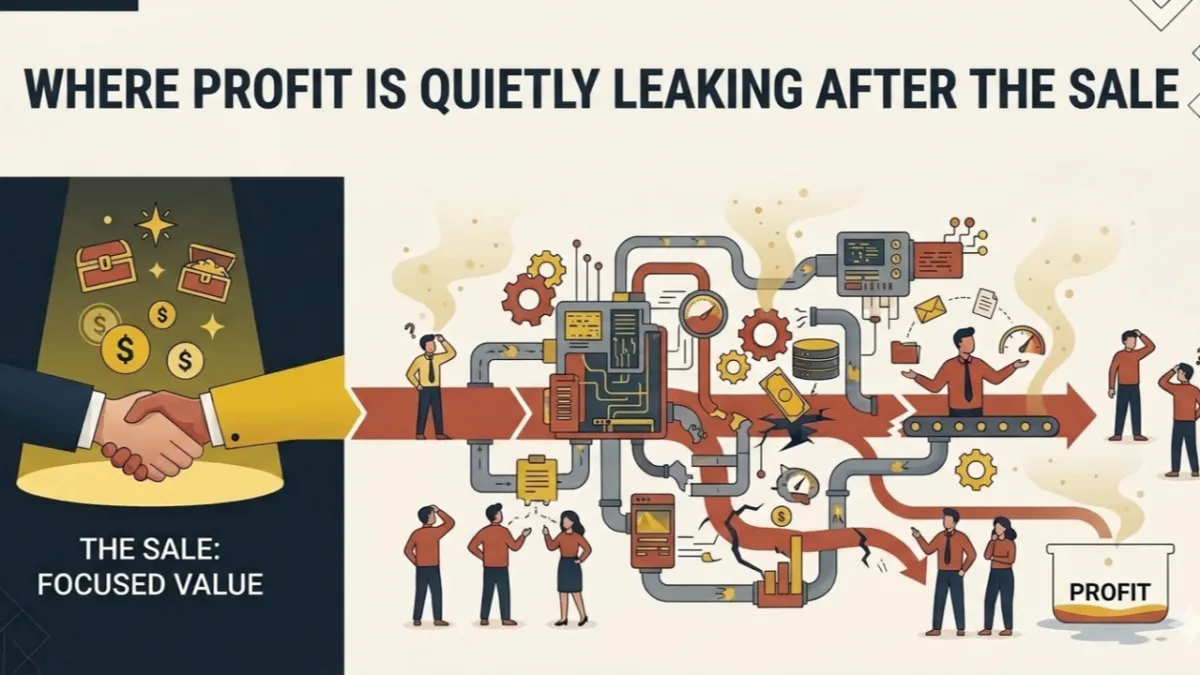
Where Profit is Quietly Leaking After the Sale
Where Profit is Quietly Leaking After the Sale
I've been talking with a couple of clients recently who want to grow their businesses, but they're concerned about having to increase what they're spending on marketing.
Both assumed it was a marketing problem. Maybe the messaging wasn’t landing. Maybe they should try a different approach or a new platform.
However, we didn’t start with any of that.
Instead, I asked them to walk me through what actually happens when a new customer says yes.
Not the version in their head or how it’s supposed to work. What actually happens, step by step, this week.
Here’s some of what we found.
The welcome email went out anywhere between the same day and three days later, depending on how busy things were. It was rewritten almost every time, or copied from an old one and half-edited. The tone varied. The details varied. Sometimes it included everything the customer needed. Sometimes it didn’t.
The team member responsible for setting the customer up didn’t always get through the process in one go. They'd have to answer the phone or help another customer. Sometimes the customer wasn't set up in the system straight away and had to request access. Sometimes they didn't receive part of what they'd paid for.
The handoff from whoever closed the sale to whoever delivered the service was haphazard. Sometimes it happened in a quick chat in the hallway, or sometimes via a forwarded email.
None of it was dramatic. Every individual issue was small. The team was working hard.
But here’s what is hidden in the day-to-day process.
This wasn’t just an operations problem. It was a brand problem.
Think about what’s happening in the customer’s mind at this exact moment.
They’ve just made a buying decision. They’re hopeful, but not yet certain. There’s almost always a quiet voice asking: Did I make the right choice?
That’s the most fragile moment in the entire customer relationship. And for most businesses, it’s also the most neglected.
Because the business has moved on. The sale is done. The team is busy. The owner is already focused on the next thing.
But the customer hasn’t moved on. They’re watching. They’re forming an impression of what this business is actually like to deal with. And every inconsistency, every delay, every moment of confusion is quietly answering their question: maybe I shouldn’t have.
The first sale is always the most expensive sale. You’ve invested the time, effort and marketing spend to earn that customer’s trust. And then the onboarding experience, the very first real interaction they have with your business, either reinforces that trust or starts to erode it.
When it erodes, you don’t usually hear about it directly. The customer may not complain. They just quietly disengage. They don’t come back as often. They don’t refer their friends. And the business owner is left wondering why retention is soft and referrals are inconsistent.
What looks like a marketing problem may not be. There's no point spending more money on marketing if you are going to inadvertently turn customers away after their first purchase.
What these businesses need first is to make a first impression that leaves the customer delighted with their choice.
But most business owners don't see the issue. It doesn't show up as an expense in the P&L that keeps growing. There's no line item for opportunity lost.
Often the knowledge of how onboarding should work lives in the owner's head or on a checklist someone wrote 3 years ago that no one looks at. The standard of service was implied rather than clearly defined. The team was doing their best to support the customers.
And because nothing ever broke dramatically, it all felt like it was working well enough.
This is the pattern I see over and over again.
Not just in onboarding. But across the whole business. Knowledge trapped in the owner’s head. Standards that exist as feelings rather than measurable outcomes that are tracked weekly. Capable teams operating on "doing their best" rather than clarity.
And the symptoms show up in places that seem completely unrelated to the cause. Retention looks like a marketing issue. Inconsistent service quality looks like a people issue. The owner being pulled into everything looks like a delegation issue.
But underneath all of them, the same thing is usually going on. The workflow, the decision-making frameworks and the service standard are not visible.
Mapping an onboarding process does not take days. It can be done in an hour or two. We follow the workflow from the moment a customer says yes to the point where they were fully set up and receiving the product or service.
What is often surprising isn't the complexity. It's how many decisions and handoffs are happening that the business owner hasn't consciously thought about.
Steps that relied on the owner being available, particularly for exceptions.
Quality that depended on who happened to be doing the work that day.
Moments where the customer’s experience was being shaped by chance rather than intention.
Once you see it in your business, you can't unsee it. And you notice the same patterns in other parts of the business.
That’s the thing about mapping even one process honestly. It doesn’t just fix that process. It changes how you see the whole system.
The reason I share this isn’t to suggest that onboarding is the most important process in every business. It might not be yours.
But the pattern underneath it probably is.
If your business has knowledge that only lives in certain people’s heads, standards that shift depending on who’s doing the work, and symptoms that keep showing up in places you can’t quite explain, there’s a good chance your business is telling a story you haven’t written.
And your customers are reading it every day.
If you followed a new customer through their first two weeks with your business, not the version you imagine but what actually happens, what story would they say your business is telling?
Until next week,
Kylie
