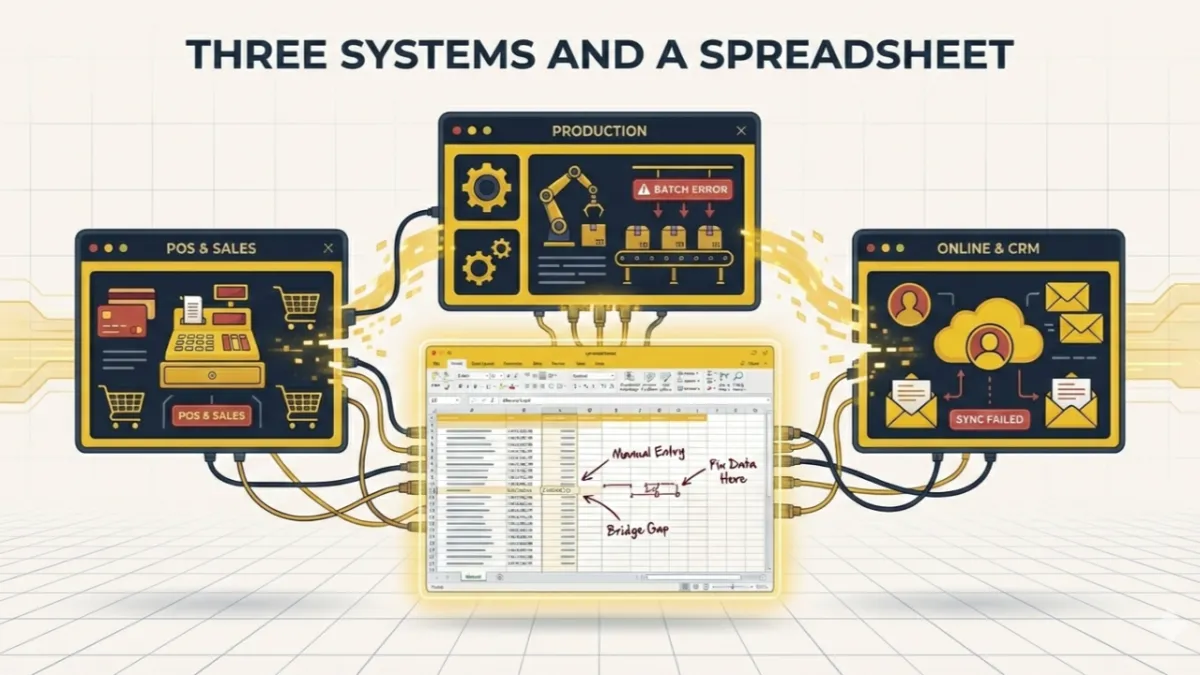
Three Systems and a Spreadsheet
Three Systems and a Spreadsheet
You're in the demo. The sales rep is walking you through the CRM. It looks great. Clean interface. Dashboards. Automations. You're nodding along.
Then you ask the question.
"Can it pull our customer purchase history from the POS and match it against our online orders and manual invoices so we can see who's buying through which channel?"
Silence.
"You’d probably need a custom integration for that."
And there it is. Every business owner I know has had some version of that moment. The software looks perfect right up until you describe how your business actually works.
And when your business doesn't match the assumptions baked into the software, the problem is yours to solve.
I know this because we live it.
We have a family winery. We grow our own grapes, we buy some in, we manufacture on site, and we sell through five different channels: cellar door, online, wholesale to restaurants and bottle shops, distributors, and export.
After a recent system update, our financial system produces errors every time it talks to our online ordering system. The vendor hasn’t fixed it so our financial assistant goes in and manually cleans up the mistakes. Every week.
We've investigated CRM options. They were generally built for businesses ten times our size and I knew the team would struggle to use them. I knew we'd still end up with spreadsheets filling the gaps. So we just went with a spreadsheet solution (until now).
The batch management systems for manufacturing never quite fit our process. So we built our own. We were lucky and had the skills to design it. It was better to build something from scratch than to bend our winemaking operations around someone else's idea of how our production should work.
Three systems. Three different versions of the same story.
And it's not just us. I see this in every business.
The client management system that can't track the metrics the business actually cares about.
The class scheduling system that doesn't integrate well with the CRM and the financial system.
The financial system that doesn't give the actual cashflow planning the business really needs.
None of this is unusual. It’s the norm.
This isn’t a technology problem. It's a business model problem.
Software companies need scale. They need thousands of customers paying monthly subscriptions. That means they need to build for the middle of the bell curve, what the average “typical” business will need.
But your business isn’t “typical” or generic. Neither is ours.
So most small and mid-sized businesses end up with the same thing.
A patchwork.
Three systems that don't talk to each other. Two spreadsheets filling the gaps. A person whose unofficial job description includes "fix the things the software was supposed to handle."
I'm certainly not saying every piece of software is bad. Most of it is very useful and high quality or it wouldn’t have survived in the marketplace.
Nor am I suggesting that business owners should build everything from scratch. That's not realistic either.
For decades, the only real options for small and mid-sized businesses were:
buy something off the shelf that partially fits the business, or
spend 5-6 figures on custom IT development.
Neither option was ideal. So most of us picked the less bad one and made it work through workarounds, manual effort, and quiet frustration (or sometimes very loud frustration!)
That's been the reality for a long time, but now things are changing
The cost and complexity of building systems shaped around how your business actually operates has shifted in ways many business owners haven’t caught up to yet.
It means the idea that you’re stuck choosing between “almost right” and “prohibitively expensive” isn’t as true as it once was.
And if you’ve spent years working around systems instead of being fully supported by them, that’s worth paying attention to.
The options and tools are improving and changing rapidly.
But the hardest part isn't the technology. It's the same thing it was 30 years ago when I first started implementing ERP systems.
The hard part is knowing what you actually need, what outcome you want.
It’s knowing how work really flows through your business and exploring how that could be improved with new processes, systems and tools.
It’s knowing where the friction is.
Get that right and the tools will follow. Get it wrong and you'll end up with a shiny new patchwork instead of the old one.
So here’s a question to think on.
How much of your team’s time goes into working around systems that were supposed to save them time?
Until next week,
Kylie
