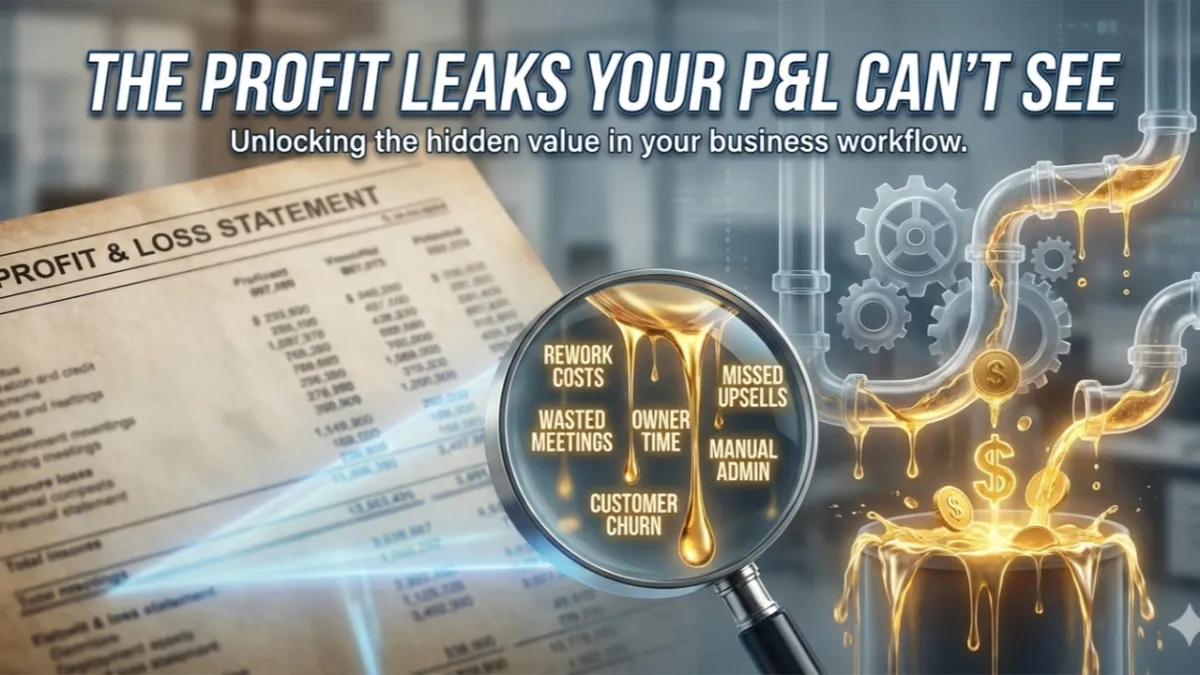
The Profit Leaks Your P&L Can't See
The Profit Leaks Your P&L Can't See
Most business owners look for issues with profit in their financials.
But some of the biggest profit losses don't show up on the Profit and Loss Statement at all. It isn't designed to show them.
The real issue is invisible profit leakage. It's money lost through how work actually flows through the business, not through anything you can see on the P&L.
Once people are on salary, their time feels costed. Rework hides inside normal operations. Owner effort is rarely fully costed. And opportunity cost never appears anywhere.
Which means a business can be quietly leaking thousands of dollars a month without anything looking obviously wrong.
To make this tangible, here’s what that can look like in a service business.
$1,500 / month – delays and rework caused by unclear processes
$2,000 / month – wasted meetings and decision bottlenecks
$3,000 / month – owner time spent on work that should be automated or delegated
$1,000 / month – customer churn from slow delivery or avoidable errors
$1,000 / month – missed upsells due to scattered or inconsistent follow-up
$1,500 / month – manual admin that could be systemised or automated
That’s $10,000 a month.
This money isn't lost in one dramatic moment but rather it disappears quietly, through the way work flows through the business.
Manufacturing businesses see the same issue just in different places. The leakage often shows up as:
Downtime and changeovers that take longer than they should
Scrap and rework that’s treated as “normal” rather than diagnosed
Over-batching that ties up cash in work-in-progress
Planning decisions that create overtime, expediting, or missed delivery windows
Owner involvement in scheduling or problem-solving because systems can’t cope
Again, none of this appears neatly on a single line of the P&L.
But it all goes straight to the bottom line.
This is where leverage actually lives in a business.
Not in working harder. Not in adding more activity. But in removing friction where it limits results.
You’re already paying for the team. You’re already buying the materials. You’re already carrying the overhead.
Optimising how those resources are used creates profit without needing more sales.
And this is where many businesses get the sequence wrong.
There’s little point pushing harder and investing heavily on sales and marketing if profit is leaking through delivery, decision-making, or execution. When the underlying system isn’t sound, more demand just amplifies the problems.
And this is where focus becomes critical.
When improvement efforts aren't aimed at the part of the system that's constraining results, more sales and marketing just pushes more volume through a broken flow.
Efficiency is the outcome, not the objective.
So, where does work in your business feel harder than it should even though everyone is busy and doing their best?
Until next week,
Kylie
